Sunday, October 27, 2013

On psychological integrity

It must be hard to participate in diversity programs these days. I mean, I know people who spend considerable amount of time encouraging, say, women, or people of color, to join graduate programs in science. But these same people spend at least a hour a week ranting about an oversupply of PhDs, and the scarcity of job offers. Mathematically both claims are 100% correct and valid: we DO need more women in science, and we definitely need more people of color in science, even with current job market situation, but psychologically it must be hard to switch between these two mindsets.

At least I totally don't know how to switch between these mindsets effectively. I seriously considered going to an outreach session like that, because it's fun, and a right thing to do,  but then I realized that I'm rather likely to have a slip of the tongue, and say something inappropriate, or even embarrassing. Because how do you even phrase it? Hey people, this whole graduate school thing is an extremely risky, and in fact somewhat silly and delusional affair, and only about 5% of 1st year graduate students will make it to a TT position. But please come, because your chances (as, say, diversity candidates) are actually somewhat higher, and at least 10% of you will get TT jobs! Which is like a lot higher, if you think of it, twice higher than the average, but still - really - it is so unbelievably risky! How do you encourage people en masse to follow a path that is that uncertain?.. Or rather, how can you do it responsibly, without compromising your conscience?

I don't know. That's a freakishly hard, complicated, and loaded topic. For now I decided to just quietly withdraw and hide from this particular type of outreach. Encouraging people to go into college, or to a medical school, is easy and pleasant. Straightforward psychological "You can do it" type of encouragement totally works here, I think. But with the graduate school - maybe not so much. I guess I'll take a pause and wait for a while, at least until my mind clears.

Tuesday, April 23, 2013

Eating food for science: on the importance of it

The biggest problem with our local Neuroscience department is the absence of a canteen, or a cafeteria of any kind. And the issue here is not that we are undernourished, but that the science suffers.

Think of your favorite conference. The talks may be nice, and the posters - quite awesome, but arguably the most important information you can get, be it some nitty-gritty aspects of experimental techniques, anecdotal findings, wise career advice, or even  scientific gossip - all this stuff gets discussed at the lunch tables! It's similar to how most important ideas come to people when they are taking a shower, or are walking back home: the same exactly thing is true about the scientific interaction. It works best when it is fluid and casual.

And don't even get me started on the necessity of sharing tables with people you don't know! People working in different labs, fields, even disciplines! So what is that you study? Reticulopenducular network of the freshwater sea urchin esophagus? And how is it going?

Lunch talk is the column, the pillar, and the basement on which the building of Science stands!

And still we don't have any canteen here. Not even a set of dirty red coaches around an expensive coffee machine. Even this would have worked! But we have nothing. I guess whomever planned this building was pretty ignorant about science. So we just sit in our lab spaces, barely knowing names of people working on the same floor. What's about one floor up or down, you say? Don't be ridiculous. I would not be able to even recognize them on the street.

Something should be done about it =)

Monday, April 22, 2013

PeerJ is moving forward

I really like the PeerJ initiative for some reason, and while I have not yet published anything there myself, they seem to become more and more attractive as a venue. Recently they got indexed by PubMed (as well as other scientific indexing services), and also they now let undergraduates publish for free (assuming that they have a "normal" senior co-author publishing with them).

Now look at this beautiful little paper:
https://peerj.com/articles/64/

...and realize that practically there's no excuse in having orphan data anymore. Anything that was done properly should be published, even if it's negative data, or the project was abandoned, or it does not tell a story, or whatever.

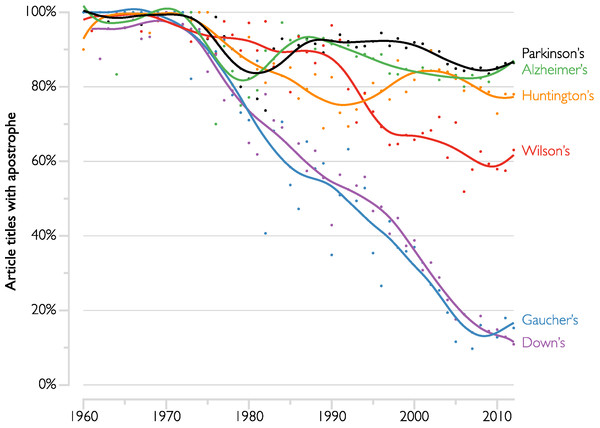
And a bonus: some nice infographics, also from PeerJ =) Evolution of de-facto grammar standards for the names of some famous diseases:


Wednesday, March 20, 2013

This whole "alternative careers" thing isn't worth the fuzz

I don't get it when people say that "alternative careers" in academia are not supported enough. How so? Virtually all academic training is about the alternative career!

That is the main career path, the one followed by ~90% of grad students and postdocs, the one that involves leaving academia at some point, that is not paid enough attention to. Even though most people who are working in academia this very moment will eventually leave academia, they don't receive enough training to prepare them for this step. This is bad.

Conversely, the "alternative path", taken by only 5-10% of people, which eventually leads to a tenure track position in a research university, is surprisingly well covered. All these postdocs, publications, conferences... All for one small alternative path. Isn't it strange?

So stop complaining about "alternative careers", and better concentrate on the "mainstream career": the one that leads out. At least pay some attention to it. Think of it. It's much more realistic.

Thursday, March 14, 2013

Google decided to close the Google Reader service

Wow, bad news. Just half a year passed since I started reading Neuroscience-related blogs on a regular basis, and now Google takes from me the way to read them. I almost can not believe it. Google Reader seemed to be such a great, sane alternative to all these attention-snatching noisy services like Facebook and Twitter... Slow, careful, thoughtful environment. And now it is there no more. What a shame!

Here's a nice discussion about the whole affair. And, well, I don't yet know what to do. Maybe I'll find another RSS aggregator (maybe this one, or this. Or maybe this.). But just in case, let me list here some key blogs I read. Just as a reserve copy (even though this blog platform is also owned by Google... oh screw it!)

(cups his hands around the mouth and shouts) - Google, if you hear me, don't be evil!

Anyway. Here's the list.

http://isisthescientist.com/
http://scientopia.org/blogs/proflikesubstance/
http://scientopia.org/blogs/drugmonkey/
http://scientopia.org/blogs/bridgeblog/
http://scientopia.org/blogs/drbecca/
http://scientopia.org/blogs/neuropolarbear/
http://drtheron.com/
http://neurodojo.blogspot.com/
http://sciencebysummer.com/
http://babyattachmode.blogspot.com/
http://academic-jungle.blogspot.com/
http://persistentastonishment.blogspot.com/
http://mindfulhack.blogspot.com/
http://rxnm.wordpress.com/
http://scientopia.org/blogs/trainingprofessor/
http://thetightropeblog.wordpress.com/
http://scientopia.org/blogs/science-professor/
http://phenomena.nationalgeographic.com/blog/the-loom/
http://phenomena.nationalgeographic.com/blog/not-exactly-rocket-science/
http://phenomena.nationalgeographic.com/blog/only-human/
http://phenomena.nationalgeographic.com/blog/laelaps/
http://mikethemadbiologist.com/
http://calnewport.com/blog/
http://blogs.discovermagazine.com/discoblog/
http://blogs.discovermagazine.com/d-brief/
http://blogs.discovermagazine.com/gnxp/
http://blogs.nature.com/actionpotential
http://neurologicalcorrelates.com/wordpress/
http://www.guardian.co.uk/science/neurophilosophy
http://neurocritic.blogspot.com/
http://dynamicecology.wordpress.com/
http://getalifephd.blogspot.com/
http://theprofessorisin.com/
http://bjoern.brembs.net/

Wednesday, March 6, 2013

The Wheel of Time book series: the dynamics of sequel ratings

I am reading The Wheel of Time series. I've just finished volume 3, and by now I am somewhat tired, but not quite tired yet to quit. Still I am kind of unsure and undecided about whether I should go further or not. Or maybe take a break. Or maybe skip a volume or two.

To answer this question I downloaded book ratings from GoodReads, and visualized them. So for those of you who care, let me share the results =)

Most books are rated by quite a few people (about 30 thousands at least), so in terms of the spread these values should be quite tolerable. The biggest methodological problem with these numbers is that the further into the series, the more faithful and fantasy-oriented the readers in the pool would become, and it should certainly introduce a bias. I prefer to ignore this bias however, as I have no idea about its direction! More faithful readers may score the books slightly higher (because they are faithful, and so like them!), but at the same time they are also humans, and so they should gradually get tired, and thus score the books lower compared to the first volume. Also faithful readers may have higher standards for the books of this kind, as presumably they read dozens of them; unlike those who only "tried" the series... So, I don't know how to correct for this bias. Let it be.

Another thing we could look at in the GoodReads data is the "Readers retention score": share of people who managed to read book #i+1 after finishing the book #i. There's a pretty stable decline in reader numbers through the series, with the first book scored by 96 thousand people, and the twelve-st scored "only" by 38 thousands. At the same time, surprisingly, if you calculate the retaining index, it doesn't change that much across the series, except for a huge outlier at the book #11: the last one R. Jordan managed to write before he succumbed to cancer. I don't yet know whether the book is really that good, or whether it is just extremely intriguing, or maybe fresh, or maybe people paid attention to this whole real-life story around the fantasy world, with one author dying, but leaving extensive notes to his colleagues to finish the series... It may be. But it means that at least this book should probably be read, even if I decide to skip a few in the middle.


I can not use this index to measure books #13 and 14, unfortunately, as book #14 is the last one (i+1 doesn't exist), while book #13 was published too recently, and so has a relatively low number of readers. I guess, it also means that this plot has an even stronger positive bias just because of unequal exposure of books to time, so to say. It does probably also have a positive bias due to the "self-selection of faithful readers" described previously... Still it is funny that the "retention values" don't correlate with the rating at all (r = -0.2; p = 0.5). It's kind of weird.

Anyway, for me personally this data probably means that I'll try the fourth book. But if it doesn't quite work, I'll skip straight to book #11.

A postdoc song?

I have stumbled upon a song that neatly summarizes my experiences as a postdoc. It may not be 100% true, but it covers most of the phenomena! It is actually surprising that the title of the song doesn't even mention postdochood. At the same time, it may be a conscious omission. Just to make the hints more obvious =)